CLEARRULES · OPINION
What Facebook does when you ask to see less
You can use ordinary words to ask for less AI content or to stop seeing a particular creator. Meta’s engineering explanation describes different actions behind those requests. Users deserve to know the difference.
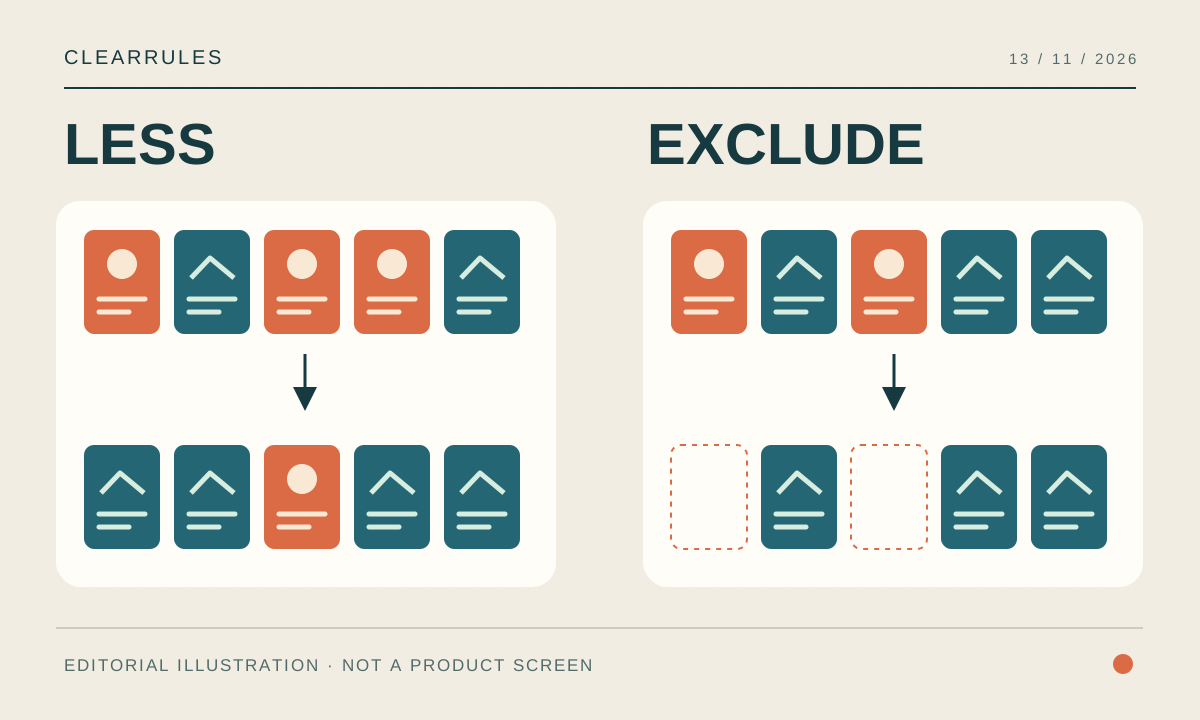
“Show me less of this.” In conversation, that sounds clear enough. In a feed setting, it raises two questions: what counts as “this”, and how much less? On 10 November 2026, Meta’s engineers explained the system behind Your Algorithm, Facebook’s recommendation controls. One detail is particularly useful: requests that feel equally natural to a person can produce different kinds of action.[1]
In Meta’s account, a request for less AI-generated content lowers its ranking. When an entry in Not Interested In names a creator, that creator’s content is filtered out directly. This is the company’s explanation, not a result we have tested. Even so, it distinguishes two expectations worth keeping separate: seeing something less often and no longer receiving a particular creator’s posts.[1]
A conversational request still needs a precise answer
Imagine someone who has had enough of synthetic kitten pictures. They might ask for less AI-generated imagery, or ask not to see the particular creator posting it. In everyday language, both requests address the same annoyance. The expectation differs: in the first case, the person can assess the mix of recommendations; in the second, they will notice that particular creator returning.
Lowering a ranking can be useful in its own right. A more pleasant feed does not always require a topic or a way of making pictures to disappear entirely. The problem comes when an interface says a reassuring “Done”, leaving the person unsure what has been done. That is not a claim about Facebook’s current wording. It is a basic standard for any assistant: the reply should name the action the person can expect.
For ClearRules, the priority here is an understandable confirmation. A request for less of a kind of content should be answered with an explanation that it will be recommended less often. A request about a creator should identify whose content is being excluded from recommendations. That takes slightly more space than a polite nod. It also spares the user from working out which part of the reply is a promise and which is merely good manners.
Judge the result against the promise
Meta’s October announcement introduced Your Algorithm as a way to influence Feed and Reels through words, with recommendations changing within the same session, according to the company. The new technical explanation is useful because it makes a sharper question possible. Instead of asking whether an algorithm “listens” in general, ask whether the result matches the action the person was told to expect.[2]
That is a sensible criterion for a future test. A request to see something less often cannot fairly be judged by the very next video: it needs comparable stretches of viewing before and after the change. Excluding a named creator calls for checking whether that creator’s own posts appear in the recommendations covered by the setting. Combining both requests into one verdict of “works” or “does not work” would erase the very distinction Meta has now explained.
Being able to describe your preferences in your own words is more convenient than fitting them into somebody else’s list of topics. That benefit deserves recognition. The next step is equally practical: tell the person, in equally clear words, what will change. The more freedom people have in making a request, the more precise the system’s answer needs to be. Otherwise, a friendly conversation leaves them with the least friendly part of old-fashioned settings: having to work out the consequences themselves.